
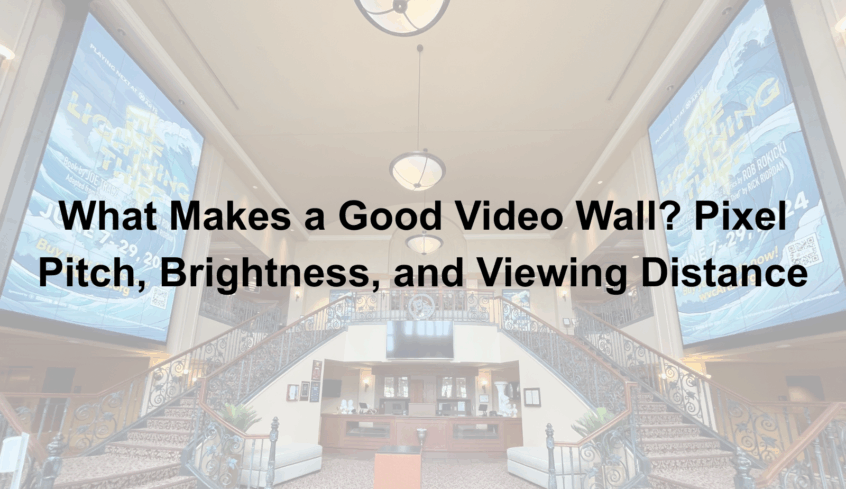
Video walls have become a staple in modern environments—city buildings, universities, control rooms, performing arts centers, corporate lobbies, and entertainment venues across Utah and Arizona all use them to deliver impactful visuals and real-time information.
But choosing the right video wall can feel overwhelming. With so many specs and technologies to compare, many teams aren’t sure what matters most—or how to avoid costly mistakes.
At TPI, we design and integrate video walls for clients throughout Salt Lake City, West Valley City, Phoenix, Tempe, Scottsdale, and Mesa, and we’ve learned one thing:
A great video wall comes down to three critical factors—pixel pitch, brightness, and viewing distance.
Let’s break down what each of these actually means (in simple terms) and how they affect your final image quality.
1. Pixel Pitch — Why Smaller Isn’t Always Better
Pixel pitch refers to the distance between the centers of two pixels on an LED module. It’s measured in millimeters (mm), such as 1.2mm, 1.5mm, 1.9mm, 2.5mm, etc.
What Pixel Pitch Tells You
- Lower pixel pitch = higher resolution at closer distances
- Higher pixel pitch = more cost-effective for long-distance viewing
- Determines how “smooth” or “grainy” content appears
Choosing Pixel Pitch Based on Utah & Arizona Use Cases
- Courtrooms / boardrooms: 1.2mm–1.8mm for close seating
- Performing arts centers / lobbies: 2.0mm–2.5mm
- Large auditoriums or city halls: 2.5mm–3.0mm+
- Outdoor venues (Arizona especially): 3.9mm–5.9mm due to long viewing distances
A quick formula
Minimum viewing distance (in feet) ≈ pixel pitch × 8
Example:
A 1.5mm video wall looks great as close as 12 feet away.
2. Brightness — Why It’s Essential in Sunny States Like Utah & Arizona
Brightness is measured in nits, and it determines how well your video wall performs in rooms with windows, stage lighting, or outdoor light.
Typical Recommendations
- Indoor conference rooms: 400–800 nits
- Lobbies with natural light: 800–1500 nits
- Outdoor or glass-heavy Arizona buildings: 2500–5000 nits
- Broadcast & control rooms: 600–1000 nits (balanced brightness for cameras)
Because Utah and Arizona both have strong sunlight, even indoor displays near windows need more brightness than typical offices.
Too dim?
Content looks washed out and unreadable.
Too bright?
Can cause eye strain and harmonic flicker on cameras.
The right integrator (hi! 👋) calibrates these levels during commissioning.
3. Viewing Distance — The Most Overlooked Factor
A video wall that looks crisp up close but pixelated from far away—or vice versa—means the pixel pitch wasn’t matched to the viewing environment.
Questions We Ask Clients
- How close will the nearest viewer be?
- Is the wall primarily for text, detail, or large visuals?
- Is the content static, dynamic, or mixed?
- Will cameras ever point at the display?
Examples From Utah & Arizona Projects
- West Valley City Performing Arts Center (UT)
Large, dramatic video walls viewed from 30–80 feet → 2.5–3.0mm pixel pitch. - ASU Thunderbird School of Global Management (AZ)
Interactive educational display viewed up close → 1.2–1.5mm pixel pitch. - City of Phoenix control rooms
Operators sit close to walls → low-pitch LED and high-brightness panels.
The goal is balance: clarity without overspending on unnecessary resolution.
Bonus: What Else Makes a Great Video Wall?
While pixel pitch, brightness, and viewing distance are the big three, a professional-grade video wall also relies on:
Color calibration
-Ensures consistent brightness and color uniformity across panels.
Proper mounting structure
-Prevents sagging, gaps, or misalignment over time.
Reliable processing
-Makes sure video content scales correctly and stays smooth.
Accessible serviceability
-Front-serviceable LED panels save cities and businesses thousands over time.
Environmental considerations
-Arizona heat, Utah winter cold, and humidity are all factored into TPI designs.
The TPI Advantage for Utah & Arizona Video Wall Projects
A video wall isn’t just a display—it’s an investment in communication, experience, and visual impact.
Our team handles everything from:
-Engineering & pixel-pitch recommendations
-Signal flow & architectural coordination
-Content scaling & color calibration
-On-site commissioning
-Ongoing service & maintenance
We’ve deployed video walls in government facilities, corporate buildings, universities, city control rooms, performing arts centers, and public venues across Utah and Arizona.
If you’re considering a video wall upgrade—or aren’t sure which specs are right—our engineers can help you design a system built for longevity, clarity, and performance.