
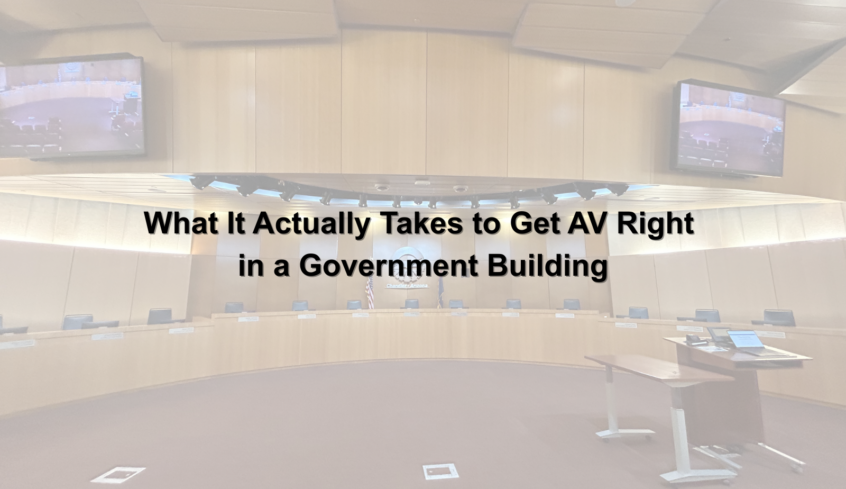
Government facilities don’t get a lot of credit in conversations about audiovisual technology. The spotlight tends to go to sleek corporate campuses or newly renovated university buildings. But in over two decades of working across sectors, some of the most complex, high-stakes AV environments we’ve encountered have been in courthouses, municipal buildings, emergency operations centers, and public meeting chambers.
The challenges are real. So is the opportunity.
The Constraints Are Unlike Anything Else
Working in government facilities means operating inside a set of constraints that most private sector projects simply don’t face.
Procurement processes are longer and more rigid. Security requirements can restrict what equipment is permitted on a network and how it’s configured. Buildings are often older, with infrastructure that wasn’t designed with modern technology in mind. And unlike a corporate office that can close for a week during a renovation, many government spaces can’t go offline. Courts have dockets. Emergency operations centers don’t get to pause.
Then there’s the budget reality. Government projects are publicly funded, which means every dollar has to be justified, documented, and often approved through multiple layers of oversight. There’s less room for iteration and very little tolerance for “we’ll figure it out during installation.”
All of this means that AV integration in government settings requires more planning, more coordination, and more patience than almost any other environment. It’s not the easiest work. It’s some of the most meaningful.
The Stakes Are Higher Than People Realize
Here’s what makes government AV different from a conference room in a corporate office: the people in the room aren’t just employees. They’re citizens, officials, first responders, and public servants making decisions that affect real lives.
Think about a city council chamber where residents come to speak during public comment. If the audio system drops out, a constituent’s voice literally doesn’t get heard. Think about an emergency operations center coordinating a disaster response across multiple agencies. If the display infrastructure fails during an active event, the consequences go well beyond a delayed meeting.
Or think about a courtroom where remote testimony has become standard practice. A poor connection, an unreliable camera, or audio that makes a witness difficult to understand isn’t just an inconvenience. It has real implications for how proceedings unfold.
The technology in these spaces carries a weight that’s easy to underestimate from the outside.
Why Getting It Right Matters More Here
In most environments, a bad AV experience is frustrating. In government facilities, it erodes something more important: trust.
When a public meeting runs smoothly, when remote participants can engage without barriers, when the technology fades into the background and the work happens the way it’s supposed to, people notice. Not always consciously, but they notice. It signals competence. It signals that the institution takes its responsibilities seriously.
When it doesn’t work, that signal runs in the opposite direction. And in a moment when public trust in institutions is something that has to be actively earned and maintained, that matters.
The Opportunity Is Bigger Than Most Organizations Recognize
For all the complexity, government facilities also represent one of the greatest opportunities in AV integration. Many of these buildings are carrying aging infrastructure that hasn’t been meaningfully updated in years. The gap between what current technology can do and what these spaces are actually delivering is enormous.
Closing that gap doesn’t just mean better meetings. It means more accessible public hearings. More effective emergency coordination. Better communication between agencies that need to work together. Courtrooms that can handle the realities of modern legal proceedings. Training environments for first responders that actually reflect the tools they’ll use in the field.
The return on a well-executed government AV project isn’t measured in productivity metrics. It’s measured in how well an institution serves the people who depend on it.
What It Takes to Do This Well
Government AV projects reward integrators who come prepared. That means understanding procurement requirements before the first conversation, not after. It means designing for the specific security and compliance environment of the facility. It means accounting for the reality that these systems will need to work reliably for years, often with limited IT support on-site.
Most importantly, it means taking the time to understand what actually happens in these spaces and who the real stakeholders are. A city IT director and a court administrator and an emergency management coordinator all have different definitions of what “working well” looks like. A project that serves all of them requires listening to all of them.
That’s true of every good AV project. In government settings, it’s the difference between a system that holds up and one that quietly becomes a liability.