
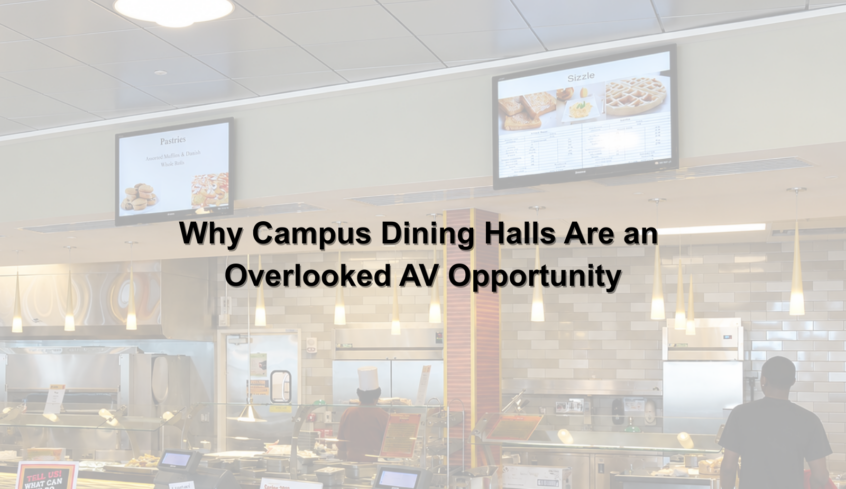
When universities plan AV investments, the priority list is predictable: lecture halls, auditoriums, classrooms, maybe a flagship boardroom for the president’s office. Dining halls rarely make the cut.
That’s a missed opportunity. Across campuses in Salt Lake City, Phoenix, and Albuquerque, dining facilities are some of the highest-traffic, highest-visibility spaces a university operates — and most are still running on printed menu boards and a single TV bolted to the wall playing the news. The gap between what these spaces could be doing and what they’re actually doing is significant.
Here’s why dining halls deserve a real seat at the AV planning table.
The Traffic Numbers Are Hard to Ignore
Think about how many students pass through a campus dining hall on a given day. Multiple times a day, every day of the academic year. Compare that to a lecture hall that fills for one or two class periods, or a boardroom that hosts a handful of meetings a week.
Dining facilities aren’t just food service spaces — they’re one of the most reliable gathering points on any campus. Research shows that a large majority of students see on-campus dining as their primary way to connect and build community, which makes these spaces some of the most valuable real estate a university has for communication, branding, and student experience, even if nobody has historically treated them that way.
For institutions in higher education hubs like Salt Lake City and Phoenix, where campus dining programs serve large and diverse student populations across multiple residential and retail locations, that traffic volume represents a significant and largely untapped audience.
Digital Menu Boards Are Just the Starting Point
The most obvious AV upgrade for a dining hall is replacing static printed menus with digital signage — and the case for that alone is strong. Digital menu boards reduce printing costs, allow real-time updates when items run out or change, and improve visibility into nutritional and allergen information that students increasingly expect to see before they choose what to eat.
But the opportunity goes well beyond menus. Dining facilities across the country are using digital signage for daily specials, wait time displays, sustainability messaging, and even climate impact labeling on menu items — a trend that’s gaining real traction as students pay closer attention to sourcing and environmental footprint. Some research has found that climate labeling in university dining settings measurably shifts students toward lower-emissions food choices.
For Albuquerque-area institutions and others serving environmentally conscious student populations, that kind of messaging isn’t just informative. It’s a meaningful way to align dining operations with broader campus sustainability goals.
Wayfinding and Wait Time Don’t Have to Be a Mystery
Anyone who has navigated a crowded dining hall during a lunch rush knows the friction points: which station has the shortest line, where the allergen-free options are located, whether the grill is even open yet.
Digital signage paired with simple sensor technology can solve this in real time. Wait time displays, station status updates, and live occupancy data give students the information they need to make decisions before they’re standing in a slow-moving line. Some universities have started using privacy-safe occupancy sensors specifically to manage dining traffic and staffing more efficiently — turning a guessing game into a data-driven operation.
That’s a meaningful upgrade to the student experience, and it’s a problem AV and digital signage are uniquely positioned to solve.
A Built-In Channel for Campus Communication
Here’s where the opportunity gets bigger than just dining operations. A dining hall with networked digital signage isn’t just managing menus — it’s a high-traffic communication channel that most campuses are leaving on the table.
Event promotion, academic deadlines, athletics schedules, weather alerts, and emergency notifications can all run through the same displays that show the lunch menu. Universities running unified, campus-wide signage networks have found that dining facilities are some of the most effective locations for this kind of messaging, precisely because students are a captive audience standing in line with a few free minutes and nothing else to look at.
That’s a far better use of the space than a single muted television tuned to a 24-hour news channel that nobody’s actually watching.
Emergency Communication Coverage You’re Probably Missing
This is the piece that often gets overlooked entirely: in an emergency, every screen on campus matters, and a dining hall packed with hundreds of students during peak hours is exactly the kind of space that needs to receive critical alerts instantly.
A properly integrated digital signage network can switch every connected display, including the ones in dining facilities, to emergency messaging the moment it’s triggered, supplementing whatever campus-wide notification system is already in place. If your dining halls aren’t part of that network, you have a real gap in your emergency communication coverage during some of the highest-occupancy hours on campus.
For government-funded public institutions across Utah, Arizona, and New Mexico, where emergency preparedness requirements continue to tighten, that gap is worth closing sooner rather than later.
The Business Case Isn’t Complicated
None of this requires the kind of capital investment that a lecture hall renovation or auditorium upgrade demands. Digital signage hardware and content management platforms are relatively modest investments compared to most campus AV projects, and the return shows up quickly: lower printing costs, reduced staff time spent manually updating menu boards, better student satisfaction scores, and a meaningful upgrade to emergency communication coverage.
For university facilities and IT teams across Salt Lake City, Phoenix, and Albuquerque planning their next round of campus technology investments, dining halls are worth a serious look. They’re high-traffic, currently underutilized, and one of the easier wins available compared to a full classroom or auditorium AV overhaul.
Don’t Overlook the Obvious Spaces
The instinct to prioritize lecture halls and auditoriums makes sense. Those are the spaces where instruction happens, and they’re rightfully a priority. But the dining hall is where students actually spend unstructured time every single day, and right now, most universities are leaving that space dramatically underused as a communication and experience tool.
Sometimes the best AV opportunity isn’t the flashiest room on campus. It’s the one everyone walks past three times a day without thinking twice about it.