
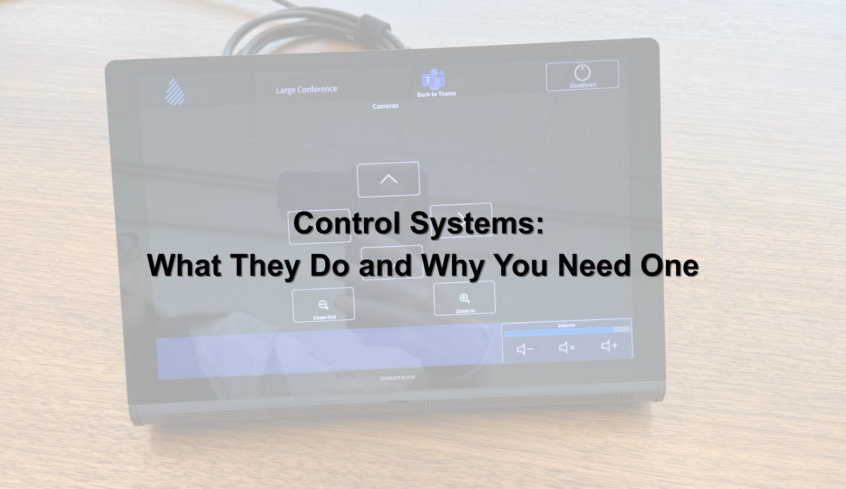
If you’ve ever walked into a meeting room and tapped a single button to bring the displays to life, lower the shades, adjust the lighting, and connect to the call — that was a control system doing its job. Quietly, instantly, and without you having to think about it.
Control systems are one of the most impactful components of any AV environment, and one of the least understood. Most people experience them without knowing they’re there. And organizations that skip them almost always feel the absence.
Here’s a straightforward look at what control systems actually do, and why they’re worth understanding before your next AV project.
What a Control System Actually Is
At its core, a control system is the brain of your AV environment. It’s the layer of technology that sits between your hardware and your users, translating a simple command into a coordinated set of actions across multiple devices.
Without a control system, each piece of equipment in a room operates independently. You have a display with its own remote. A source switcher with its own interface. A camera with its own controls. An audio processor with its own settings. Getting a meeting started means interacting with each of those separately, in the right order, with the right inputs selected.
With a control system, all of that gets unified into a single interface — usually a touchscreen panel, a tablet, or increasingly a mobile device. One tap, and the system takes care of everything else.
What It’s Actually Doing Behind the Scenes
When you press “Start Meeting” on a well-programmed control panel, a lot happens in a short amount of time.
The display powers on and switches to the correct input. The camera activates and moves to its default position. The audio system adjusts to the room’s preset levels. The lighting shifts to the meeting preset. If the room has motorized shades, they lower. If the HVAC is integrated, it adjusts. The video conferencing platform launches and connects to the scheduled call.
All of that happens in seconds, in the right sequence, without the user managing any of it. That’s the value of a control system — it turns a multi-step technical process into a single human action.
Why It Matters More Than People Expect
The difference between a room with a control system and one without isn’t just convenience. It shows up in a few very measurable ways.
Meeting start times. Studies consistently show that a significant portion of meeting time is lost to technology setup. When a room requires users to manage multiple devices manually, those minutes add up across hundreds of meetings a year. A control system eliminates that friction almost entirely.
User confidence. People use technology they trust. When a room is intuitive and predictable, users engage with it fully. When it requires troubleshooting or prior knowledge to operate, they work around it. The workarounds — everyone joining on their own laptop, nobody using the room camera — are a direct symptom of rooms that weren’t designed with a unified control layer.
Support burden. A well-programmed control system can include built-in diagnostics, automated device monitoring, and error handling that catches problems before they affect users. That reduces the volume of “can someone come look at the room” tickets that land on your IT team’s desk.
Not All Control Systems Are Equal
This is worth saying clearly: a control system is only as good as its programming.
The hardware platforms — Crestron, Extron, AMX, QSC, and others — are sophisticated tools. But what determines whether a control system actually works well for your organization is how it’s been programmed and configured. A poorly programmed system can be just as frustrating as no system at all, with unresponsive buttons, incorrect sequences, or interfaces that don’t match how the room is actually used.
This is where the integration partner matters enormously. Good control system programming requires understanding not just the technology, but the workflows and habits of the people using the space. It’s a design exercise as much as a technical one.
When Do You Actually Need One?
Not every space requires a sophisticated control system. A small huddle room with a single display and a laptop connection might be perfectly well served by a simpler setup.
But as soon as a space involves multiple devices, multiple sources, or multiple use cases, a control system starts to pay for itself quickly. The more complex the room, the more valuable the unified control layer becomes.
Some clear indicators that a control system should be part of your design:
A room has more than two or three AV components that need to work together. The space is used by a wide range of people with varying levels of technical comfort. The room hosts high-stakes meetings where setup friction is not acceptable. Your IT team is fielding regular support requests from a particular space. Users have stopped using room technology and defaulted to their own devices instead.
The Bottom Line
A control system isn’t a luxury add-on. It’s the component that determines whether everything else you’ve invested in actually gets used — and used well.
The best AV environments feel effortless. That effortlessness doesn’t happen by accident. It’s designed, programmed, and maintained. A control system is what makes it possible.