
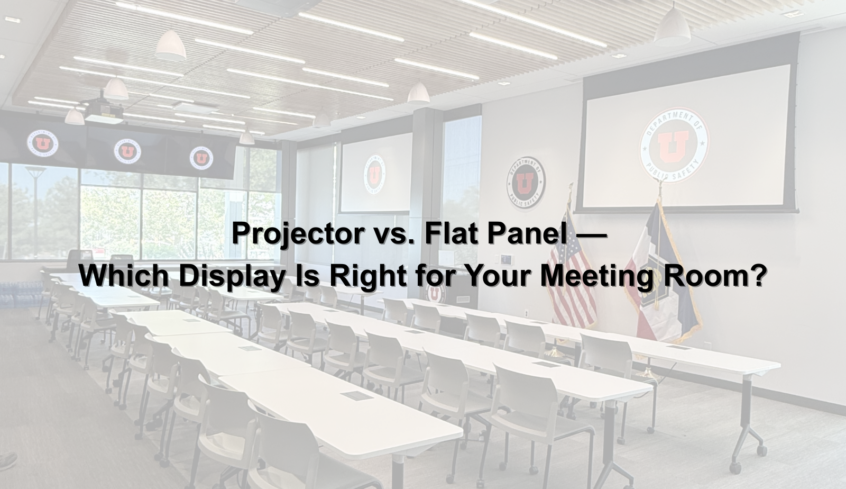
When designing or upgrading a meeting room, the display is often one of the first things people think about. But choosing between a projector and a flat panel isn’t simply a matter of preference.
Room size, viewing distance, lighting, content, budget, and how the space will actually be used can all influence which display technology makes the most sense.
Both projectors and flat-panel displays can be excellent solutions. The key is choosing the right technology for the room instead of trying to make the room fit the technology.
When Does a Flat Panel Make Sense?
Flat-panel displays have become a popular choice for conference rooms, huddle spaces, classrooms, and other collaboration environments — and for good reason.
Modern commercial displays offer bright, crisp images and perform well in rooms with significant ambient light. They’re also relatively simple for users to understand: walk into the room, start the meeting, and use the display.
Flat panels are especially well suited for:
- Small to medium-sized meeting rooms
- Huddle and collaboration spaces
- Video conferencing
- Presentations with detailed text or spreadsheets
- Rooms with significant ambient light
- Spaces where simplicity and ease of use are priorities
For organizations standardizing meeting rooms across an office or multiple locations, flat panels can also help create a consistent user experience from one room to the next.
However, there is a practical limit to how large a flat panel should be before factors like cost, installation requirements, transportation, and serviceability become more significant.
That’s where projection can have an advantage.
When Is a Projector the Better Choice?
Projectors remain incredibly useful, particularly when a space requires a much larger image.
In training rooms, lecture halls, auditoriums, divisible spaces, and large conference rooms, a projected image can provide the scale needed for everyone in the room to comfortably see the content.
Projection may be the better solution for:
- Large meeting and training rooms
- Auditoriums and lecture halls
- Spaces requiring very large images
- Rooms with long viewing distances
- Multipurpose environments
- Applications where display size is a major priority
Modern laser projectors have also changed what organizations can expect from projection. Compared with older lamp-based systems, laser technology can provide greater brightness, longer operating life, and reduced maintenance.
But projection requires careful design. Ambient light, screen placement, throw distance, ceiling height, sightlines, and projector location all need to be considered.
Simply installing a brighter projector isn’t always enough to overcome a room that wasn’t designed with projection in mind.
Don’t Forget About the Room
One of the biggest mistakes in AV design is choosing a display based solely on its specifications.
A 98-inch flat panel might sound impressive — but can everyone seated in the room comfortably read the content?
A large projection screen might seem ideal — but how much natural light enters the space during the day?
The display should be selected as part of the overall room design.
At TPI, we consider factors such as room dimensions, seating layout, viewing distance, ambient lighting, sightlines, content type, conferencing requirements, and how users interact with the space.
After all, the goal isn’t simply to install a screen. It’s to make sure the people using the room can clearly see and interact with the information being presented.
What About Video Conferencing?
Video conferencing adds another layer to the decision.
Many modern meeting rooms need to display several types of information simultaneously — remote participants, shared presentations, chat windows, meeting controls, or other collaboration content.
In some rooms, a single display is sufficient. Others benefit from dual displays or a larger-format solution that provides more visual workspace.
Camera placement also matters. An improperly positioned display can force the camera too high, too low, or too far away from participants, making virtual meetings feel less natural.
That’s why display selection and video conferencing design should be considered together rather than as separate systems.
So, Which One Should You Choose?
There isn’t one answer for every meeting room.
Choose a flat panel when you want excellent brightness, sharp detail, straightforward operation, and a clean solution for a small or medium-sized space.
Consider projection when you need a significantly larger image, have longer viewing distances, or are designing a large training, presentation, or multipurpose environment.
And in some applications, the right answer may involve multiple displays or a combination of technologies.
Design Around the People Using the Room
The best AV system isn’t necessarily the one with the biggest display or newest technology. It’s the one that makes meetings easier.
At Technology Providers Inc. (TPI), we design audiovisual environments around the needs of the organization and the people who use them. From conference rooms and training spaces to classrooms, auditoriums, and large-scale presentation environments, our team evaluates the entire space before recommending a solution.
Not sure whether a projector or flat panel makes sense for your next project?
TPI can help evaluate your space, understand how it will be used, and design an AV solution built around your needs.
Contact TPI to start planning your next AV project.