
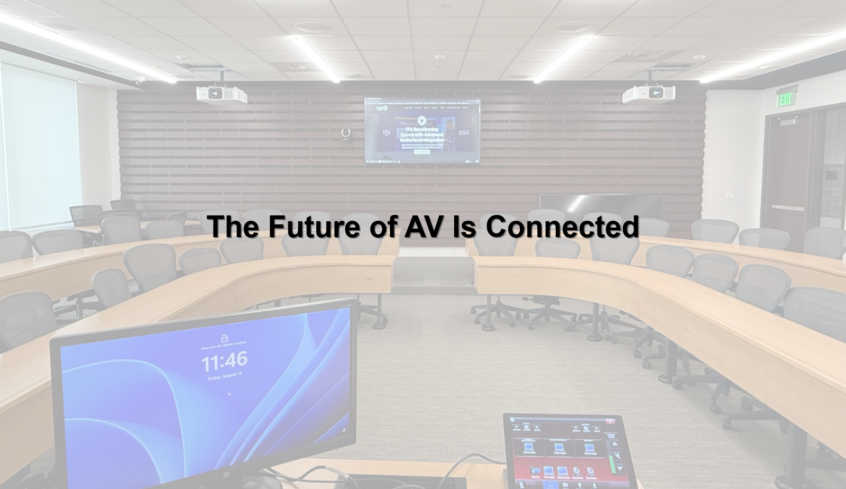
Audiovisual technology is becoming more connected than ever. From corporate conference rooms and university campuses to government facilities, organizations increasingly rely on integrated technology systems that communicate, share information, and operate across existing networks.
As technology evolves, traditional AV infrastructure is being complemented by more flexible, scalable solutions. AV-over-IP, networked audio, centralized control systems, and IT-integrated AV solutions are changing how organizations design, manage, and expand their audiovisual capabilities.
Understanding this shift is an important step toward building AV systems that support both current needs and future growth.
The Shift Toward Networked AV Systems
Traditional audiovisual systems often rely on dedicated cabling and direct connections between individual devices. While these systems remain effective for many applications, they can become difficult to expand or reconfigure as technology needs change.
Networked AV systems use network infrastructure to connect compatible audiovisual devices, allowing audio, video, and control signals to be distributed more flexibly throughout a facility.
For organizations managing multiple conference rooms, classrooms, training centers, or collaborative environments, this approach can support more coordinated and scalable audiovisual infrastructure.
AV-over-IP: A More Flexible Approach to Audio and Video Distribution
One of the most significant developments in commercial AV integration is the growing adoption of AV-over-IP (Audio Visual over Internet Protocol).
AV-over-IP technology enables audio and video signals to travel across IP networks using compatible encoders, decoders, and network equipment. Rather than relying exclusively on traditional AV switching and dedicated signal cabling, organizations can distribute content through appropriately designed network infrastructure.
For example, a university or corporate training center can use AV-over-IP to route video from multiple sources to displays throughout a building.
Depending on the system design, AV-over-IP can offer several advantages:
- Scalability: Add compatible devices and endpoints as technology requirements grow.
- Flexibility: Route audio and video to different locations without extensive physical changes.
- Centralized management: Monitor and manage compatible devices through supported platforms.
- Infrastructure efficiency: Reduce the need for certain dedicated point-to-point connections.
- Adaptability: Reconfigure spaces to accommodate changing operational needs.
However, successful AV-over-IP integration requires careful consideration of bandwidth, latency, network capacity, security, and device compatibility.
Where AV and IT Infrastructure Meet
As audiovisual systems become increasingly network-based, collaboration between AV integrators and IT teams is more important than ever.
Modern commercial AV environments often include video conferencing platforms, networked microphones, digital signal processors, control systems, and streaming devices that depend on an organization’s IT infrastructure.
Successful AV and IT integration requires attention to several factors:
- Network bandwidth: Supporting the necessary audio and video traffic.
- Network configuration: Evaluating switching capacity, VLANs, multicast requirements, and quality-of-service settings.
- Cybersecurity: Protecting connected devices through access controls, updates, and network segmentation.
- Device compatibility: Ensuring technologies communicate reliably.
- Ongoing support: Establishing procedures for monitoring, troubleshooting, and maintenance.
Addressing these considerations during system design helps improve reliability and reduce potential performance issues.
Connected AV Across Corporate, Education, and Government Environments
Connected audiovisual technology offers benefits across a variety of industries, particularly those managing multiple technology-enabled spaces.
Corporate Environments
For businesses with multiple offices, conference rooms, and training facilities, networked AV can support consistent technology deployment and centralized system management.
Integrated video conferencing, room controls, and content distribution help create more standardized experiences across corporate environments.
Higher Education
Universities and colleges rely on audiovisual technology across classrooms, lecture halls, laboratories, and collaborative learning spaces.
Higher education AV solutions incorporating networked technology can support flexible content distribution, centralized monitoring, and adaptable learning environments.
Government Facilities
Government agencies depend on reliable audiovisual systems for council chambers, public meetings, training facilities, and administrative operations.
Government AV integration can incorporate connected technology to support coordinated system management while addressing security, accessibility, and operational requirements.
Across these environments, the goal is to create technology systems that are reliable, manageable, and designed around the people using them.
Planning for Scalability and Long-Term Performance
Technology requirements rarely stay the same. Organizations expand, introduce new collaboration platforms, upgrade equipment, and adapt their spaces to changing needs.
Scalable AV solutions account for future growth during the initial planning process. This includes evaluating network capacity, selecting compatible technologies, and designing infrastructure that can accommodate additional devices and functionality.
Not every organization requires a fully network-based system. In some cases, a hybrid approach combining traditional AV connections with networked technologies may be the most practical option.
The right solution depends on existing infrastructure, operational requirements, and long-term goals.
Connected Technology Still Requires Thoughtful Integration
While connected AV offers significant opportunities, connectivity alone does not guarantee a better experience.
Effective audiovisual systems must still deliver clear audio, reliable video, intuitive controls, and consistent performance. Proper engineering, equipment selection, programming, installation, testing, and ongoing support all contribute to successful integration.
At Technology Providers, Inc, we understand that audiovisual technology must work as part of a larger environment. Our approach focuses on integrating technology, people, and ideas to develop solutions that support each organization’s unique needs.
Whether implementing conference room AV systems, upgrading educational technology, or designing audiovisual solutions for government facilities, thoughtful integration helps ensure that connected systems remain practical, reliable, and manageable.
Building for What’s Next
The future of audiovisual technology isn’t simply about adding more devices. It’s about creating systems that work together, adapt to changing needs, and support the people who rely on them.
As AV-over-IP, network integration, and connected technology continue to evolve, organizations have new opportunities to build more flexible and scalable audiovisual environments.
With the right planning and integration strategy, businesses and institutions can invest in technology that supports their operations today while preparing for tomorrow.
Planning an AV upgrade or exploring networked audiovisual solutions? Contact Technology Providers, Inc. to learn how our commercial AV integration services can support your next project.